Reading Meeting Minutes Without Mistaking Silence for Agreement
Learn to read county meeting minutes for recorded decisions, unanswered questions and omissions, so you can describe what the public record leaves unresolved.
You find a county meeting’s minutes while looking for an answer about a road closure. They record a resident’s question, then move to the next agenda item. That entry tells you the question appears in the record; it does not tell you what happened after it. Reading meeting minutes well means treating omissions as limits on what you can claim, not as clues that settle the issue.
What silence permits
Minutes are a formal account, not necessarily a transcript. A short entry can omit parts of a discussion, including replies, objections or points of agreement. If the record says nothing about an issue, the safe description is that the minutes do not record it.
That is narrower than saying nobody raised the issue, the body agreed, or the matter was settled. Silence in one document may reflect a brief summary, a different record, or no discussion at that meeting. The minutes alone may not show which explanation applies.
Keep your wording tied to the page: “The minutes do not record a response” is supportable when none appears there. “No response was given” goes further unless the record explicitly says so.
Read the wording closely
Small phrases carry different amounts of information. “A question was raised” confirms that the minutes record a question. “The chair responded that the road crew would review the route” records a reply, but not necessarily a decision by the board. “The board directed staff to report back” records a stated follow-up.
Likewise, “noted” or “discussion followed” does not identify what was accepted, rejected or left open. Avoid filling those spaces with assumptions drawn from the agenda title or from the fact that the meeting continued.
For each disputed point, note the exact wording, the speaker or body identified, and any response or task the minutes actually name. Mark anything else as unknown.
Separate omission types
Not every gap means the same thing. A useful reading separates at least three cases:
- No entry: the minutes do not mention the subject. You can say it is absent from this record, not that it never came up.
- Question without a recorded answer: the minutes note an inquiry but no reply. You cannot tell from that alone whether an answer was spoken and omitted.
- General summary: wording such as “comments were received” indicates comments, but does not identify every position or response.
- Explicitly unanswered: if the minutes say no answer was given, you can report that the record states this, while keeping the claim attributed to the minutes.
This distinction is especially useful when someone asks you to explain what a county body heard. A document can confirm that a concern was mentioned without showing how members understood it.
Follow the record trail
When the minutes leave a question open, look for records that may clarify it, rather than treating any related document as a substitute answer. Check the agenda packet, attached correspondence, later minutes and any separately available recording. An attachment may show what information was supplied; it does not prove that the body discussed or adopted it.
Confirm the meeting date and body before comparing records. A county board, planning commission and advisory committee may handle the same subject in different ways. If you cannot locate a document or need to know which version is official, ask the county clerk or records office about available records and local procedures.
Keep a simple note of each source and what it can establish. Minutes show what they record; a recording may clarify spoken exchanges; later minutes may record subsequent discussion. None should be made to answer a question it does not address.
How should you describe gaps?
Can I say the issue was ignored?
Only if the record supports that specific claim. If the minutes omit the subject, write that they do not mention it; omission alone does not show what participants did or did not consider.
Does a recorded question imply a follow-up?
No. A question in the minutes does not establish that anyone accepted responsibility for answering it. Look for an explicitly named task, referral or later response.
What if another record differs?
Note the difference and identify each source rather than silently choosing one. If the discrepancy matters, ask the county clerk or relevant records office which record is official and whether a correction was made.
A worked reading
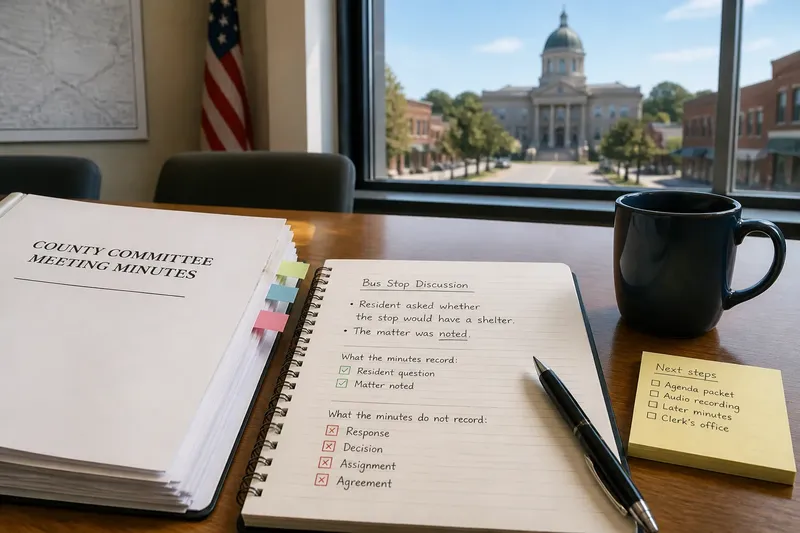
Say you are checking fictional minutes for a county meeting about a proposed bus stop. The starting entry reads: “A resident asked whether the stop would have a shelter. The matter was noted.” You want to know whether the county promised to install one.
- Identify the source: these are the minutes of the county committee meeting, not a transcript or a later board record.
- Mark what is explicit: the minutes record a resident’s question and say the matter was noted.
- Check the surrounding entry for a named reply, assigned task, referral or stated decision. In this invented situation, none appears.
- Check the later minutes and packet for a follow-up. Imagine they contain a staff note about possible shelter locations but no recorded direction from the committee.
- Write the result narrowly: “The committee minutes record a question about a shelter and say the matter was noted. They do not record a promise to install one; a later staff note discusses possible locations.”
The answer is not that the county refused or agreed. The available records leave the commitment unresolved, while showing that the subject appeared in the meeting’s account.
When you read meeting minutes, describe the entry, the omission and the source separately. That makes it easier for a reader to see what the county record supports—and where a further record or clarification is still needed.